DasBoot™ – Early Release Overview
Engine Monitoring (Inboard Engines)
Real-time display of key inboard engine parameters, providing clear insight into engine performance and overall operational status.
Fuel Consumption & Efficiency
Live fuel usage data designed to support efficient operation, voyage planning, and cost awareness.
Trim Control
Integrated trim monitoring and control for improved handling, efficiency, and ride comfort.
Internal Systems Control
Centralised control of selected onboard switches and internal systems through the digital interface, reducing physical controls at the helm.
Battery Monitoring (Engine & House Banks)
Continuous monitoring of engine start batteries and house battery banks, including voltage, current, state of charge, and health status, ensuring reliable operation and early detection of electrical issues.
Engine Hours & Service Tracking
Accurate logging of engine operating hours with automated service interval notifications, supporting timely maintenance such as oil changes, inspections, and major engine overhauls.
Bilge Pump Monitoring & Flood Detection
Real-time monitoring of bilge pump activity and bilge water levels, providing early warning of leaks, flooding, or abnormal pump cycles to enhance onboard safety and damage prevention.
The DasBoot engine monitoring system provides continuous, real-time visibility into critical propulsion parameters, enabling informed operation and early detection of abnormal conditions.
Designed to support both petrol (gasoline) and diesel engines, the system is equally suited to single- and twin-engine installations, presenting all data in a clear, consistent format across the digital helm.
Real-Time Engine Parameters
DasBoot continuously monitors and displays key engine values, including:
- Engine Speed (RPM)
Precise, real-time RPM monitoring for each engine, allowing accurate throttle control, synchronisation in twin-engine setups, and efficient cruising. - Oil Pressure
Live oil pressure readings provide immediate insight into engine lubrication health, supporting preventive maintenance and safe operation. - Alternator / Generator Voltage
Continuous monitoring of charging voltage ensures proper electrical system performance and early detection of charging or regulator issues.
Operational Alarms and Warnings
To enhance safety and reliability, DasBoot actively supervises critical thresholds and generates clear, unambiguous alerts when abnormal conditions occur, including:
- High Coolant Temperature
Early warning of overheating conditions to prevent engine damage. - Low Oil Pressure
Immediate alerts in case of lubrication failure or abnormal pressure drop. - Electrical Voltage Faults
Detection of under-voltage or over-voltage conditions affecting engine charging systems.
Alerts are presented visually on the display and can be configured to prioritise critical events, ensuring that essential warnings are never overlooked during operation.
Twin-Engine Awareness
For twin-engine configurations, DasBoot introduces a shared, comparative instrument layout designed to provide immediate visual understanding of engine balance and behaviour.
Both engines are displayed on a common gauge, using distinct red and green needles to represent port and starboard engines. This arrangement allows the operator to assess engine symmetry at a glance, without shifting attention between separate instruments or screens.
Instant Visual Comparison
By presenting key parameters—such as engine speed, oil pressure, or charging voltage—on a single scale, even small deviations become immediately apparent. Differences in RPM, load, or response are visually emphasised, supporting precise throttle matching and smoother operation.
Early Fault Detection
Subtle asymmetries often indicate developing issues long before alarms are triggered. The shared gauge concept helps reveal:
- Uneven engine loading
- Irregular throttle response
- Emerging mechanical or electrical discrepancies
This enables corrective action to be taken early, reducing wear and preventing escalation.
Reduced Cognitive Load
Traditional twin-engine helms require operators to mentally compare multiple gauges. DasBoot’s red/green needle approach simplifies this process, reducing cognitive effort and allowing the operator to maintain focus on navigation and situational awareness.
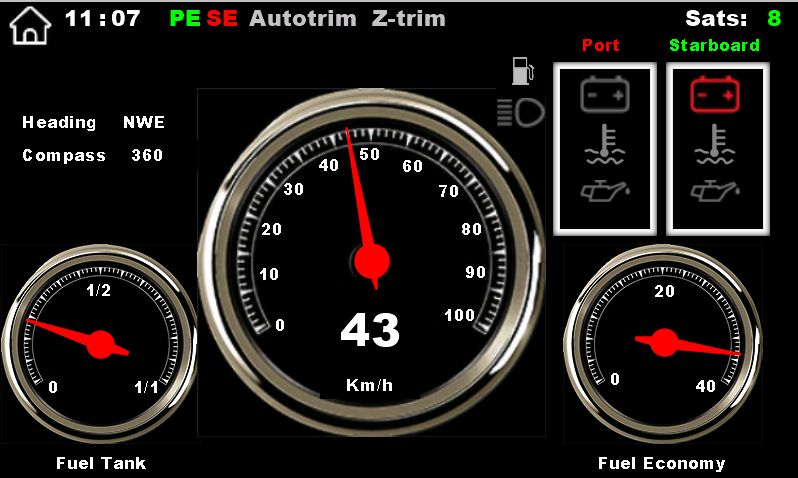
The DasBoot speed screen is designed to deliver critical underway information in a clear, instantly readable layout, optimised for both single- and twin-engine vessels.
Primary Speed Display
At the centre of the screen, vessel speed is presented using a large analogue-style gauge with a moving needle for intuitive, at-a-glance reading.
The same speed value is also shown digitally in large numerals, ensuring precise readability under all conditions.
This dual presentation combines the familiarity of classic instrumentation with the accuracy of modern digital systems.
Fuel and Consumption Gauges
Below the main speed indicator, two smaller dedicated gauges display:
-
Fuel level
-
Current fuel consumption
This layout allows the operator to continuously assess efficiency and range without leaving the speed view, supporting economical cruising and informed throttle control.
Heading and Compass Information
Heading data is displayed alongside a clear compass indication, providing constant directional awareness while underway.
The presentation is optimised for quick reference, reducing the need to switch between navigation screens during normal operation.
Engine Alarm Indication
Active engine alarm signals are clearly indicated on the speed screen, ensuring that critical warnings—such as temperature, oil pressure, or voltage faults—are immediately visible, even when the operator is focused on speed and course.
Single- and Twin-Engine Support
The speed screen automatically adapts to the vessel configuration:
-
Single-engine vessels receive a simplified, uncluttered layout.
-
Twin-engine vessels display combined alarm status and engine awareness indicators for both engines, maintaining clarity without redundancy.
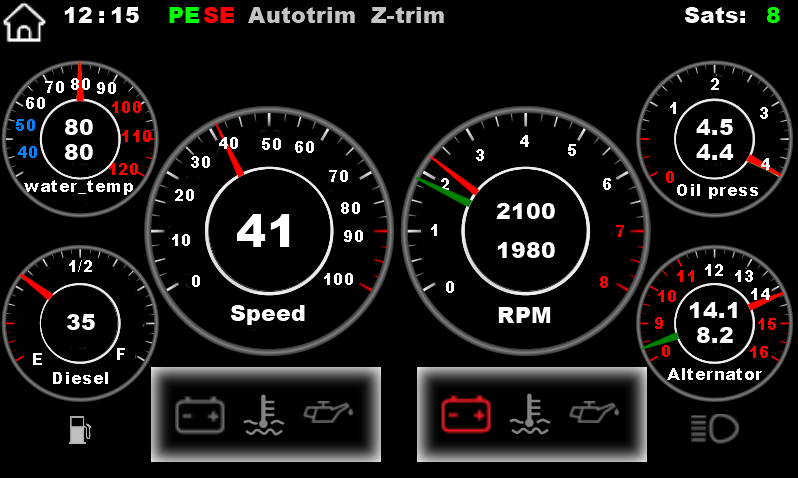
The DasBoot automotive-style screen presents essential vessel and engine information in a layout inspired by modern car dashboards—familiar, intuitive, and instantly readable.
This screen is designed for operators who prefer a classic, instrument-centric presentation while benefiting from modern digital accuracy and marine-specific functionality.
Primary Instrument Display
The screen features analogue-style gauges with clear needles, each paired with a precise digital readout:
- Speed
Large speedometer with moving needle and numeric speed display. - Engine Speed (RPM)
Tachometer showing real-time engine revolutions, displayed both graphically and numerically. - Coolant Temperature
Water temperature gauge with numeric value for accurate thermal monitoring. - Fuel Level
Fuel gauge displaying remaining fuel as a percentage (%). - Oil Pressure
Oil pressure gauge with live numeric readout for immediate lubrication status awareness. - Charging Voltage
Electrical charging indicator with precise voltage display (e.g. 13.2 V), monitoring alternator and battery health.
Warning and Fault Indicators
All active warnings and fault conditions are clearly indicated using standardised visual alerts, ensuring immediate recognition of:
- Over-temperature conditions
- Low oil pressure
- Electrical or charging faults
- Other engine-related alarms
Single- and Twin-Engine Support
The automotive-style screen adapts automatically to vessel configuration:
- Single-engine vessels display a clean, uncluttered instrument layout.
- Twin-engine vessels use red and green needles on shared gauges to represent port and starboard engines, enabling instant visual comparison and balance awareness without duplicating instruments.
This approach preserves dashboard clarity while maintaining full engine transparency.
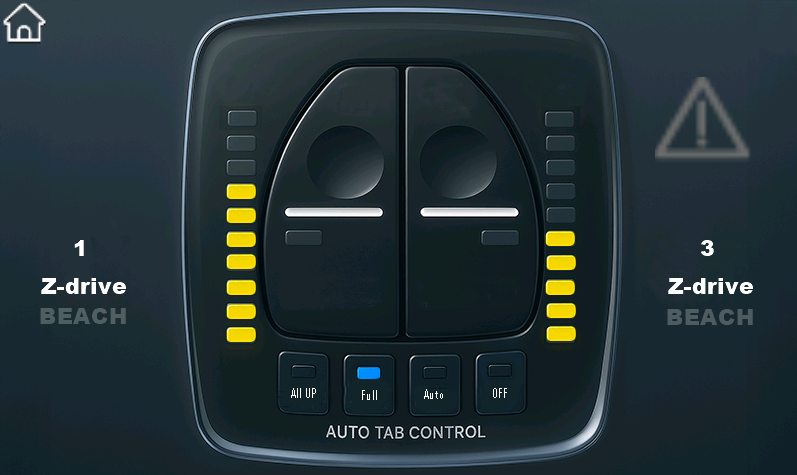
The DasBoot trim screen provides intelligent trim control and clear visual feedback, designed to optimise vessel attitude, efficiency, and comfort under all operating conditions.
Automatic Trim Control
Using data from an eight-direction gyroscope, DasBoot automatically adjusts the trim tabs to maintain optimal hull attitude and achieve a stable, efficient plane.
The system continuously compensates for changes in speed, load distribution, and sea conditions, reducing operator workload and improving ride quality.
Automatic trim control supports smoother acceleration, improved fuel efficiency, and enhanced handling, particularly during planing and speed transitions.
Manual Trim Mode with Visual Feedback
When operating in manual mode, the trim screen provides a clear visual representation of trim tab positions, allowing precise operator control.
The current position of each trim tab is displayed in real time, ensuring full transparency and predictable response to manual input.
Z-Drive Trim Support
In addition to trim tabs, DasBoot is capable of monitoring and displaying the status of Z-drive trim systems.
This enables unified visibility and control of both hull trim and drive trim within a single interface, supporting complex propulsion configurations.
Single- and Twin-Engine Compatibility
The trim screen adapts to both single- and twin-engine installations, presenting symmetrical or combined trim information where appropriate while maintaining a clean, intuitive layout.
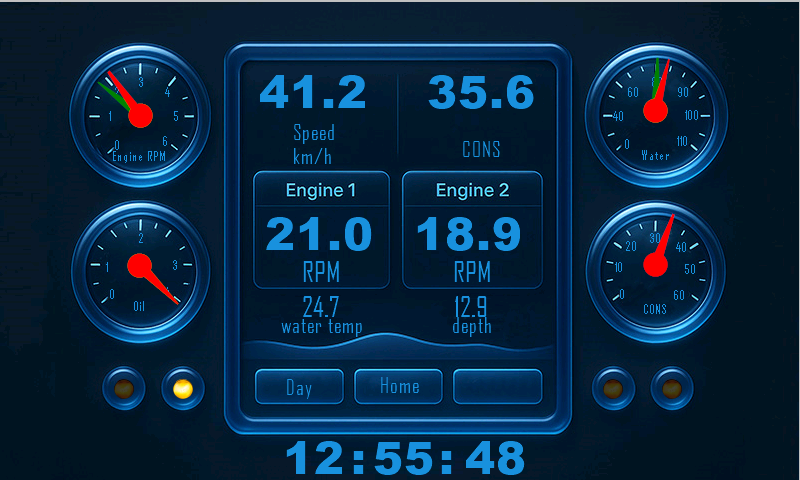
Configurable Intelligent Display
The DasBoot configurable intelligent display allows operators to tailor the screen layout to their individual preferences and operational needs, combining flexibility with consistent visual clarity.
Four Configurable Analogue Gauges
The display features four large analogue-style gauges, each of which can be independently assigned to one of the following functions:
-
Engine speed (RPM)
-
Temperature
-
Oil pressure
-
Charging voltage
-
Fuel consumption
-
Fuel level
-
Vessel speed
This enables the operator to prioritise the most relevant parameters for the current operating mode, whether cruising, manoeuvring, or monitoring system health.
Six Configurable Numeric Fields
Below or alongside the analogue gauges, the screen includes six numeric data fields, each configurable to display one of the following values:
-
Engine speed (RPM)
-
Temperature
-
Oil pressure
-
Charging voltage
-
Fuel consumption
-
Fuel level
-
Vessel speed
-
Engine hours
-
Water temperature (Requires an additional sensor or will be available via a future NMEA 2000 function.)
-
Depth (Requires an additional sensor or will be available via a future NMEA 2000 function.)
These numeric fields provide precise, at-a-glance data, complementing the analogue gauges with exact measurements.
Adaptive for Single and Twin Engines
The intelligent display automatically adapts to both single- and twin-engine installations. In twin-engine configurations, values can be shown per engine or combined, maintaining clarity without overcrowding the interface.
Operator-Focused Design
By allowing both gauge and numeric fields to be freely assigned, the configurable intelligent display supports a wide range of use cases—from traditional, instrument-focused layouts to data-rich monitoring screens—without requiring multiple dedicated displays.
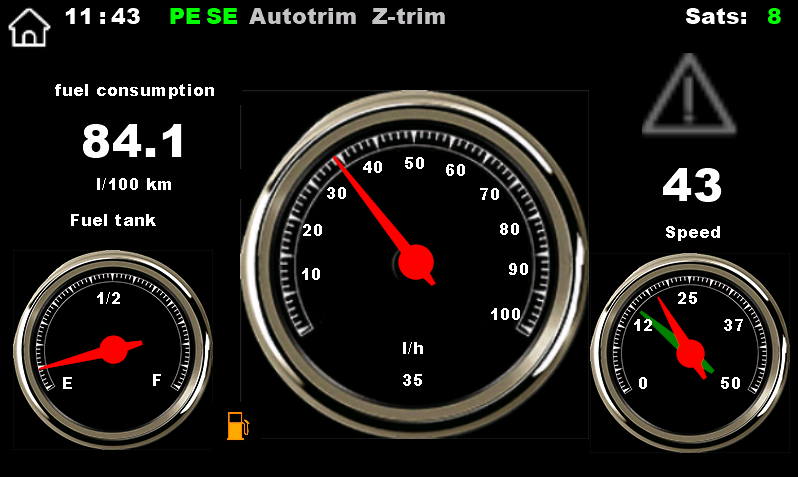
The DasBoot consumption screen provides a clear, real-time overview of fuel usage, allowing operators to monitor efficiency, plan range, and optimise vessel operation with confidence.
Total Fuel Consumption
At the centre of the screen, total instantaneous fuel consumption is displayed using a large analogue-style gauge, offering immediate visual feedback on overall fuel usage.
The same value is simultaneously shown numerically for precision, with support for multiple units, including:
-
Litres per hour (L/h)
-
Gallons per hour (GPH)
This dual presentation ensures both intuitive understanding and exact measurement.
Per-Engine Fuel Data
Smaller dedicated gauges display:
-
Fuel level
-
Fuel consumption per engine
In twin-engine configurations, each engine’s consumption is shown individually, enabling quick comparison and detection of imbalance or inefficiency between engines.
Efficiency Metrics
In addition to instantaneous consumption, DasBoot calculates and displays fuel efficiency using distance-based metrics, selectable by the operator, including:
-
Litres per 100 kilometres (L/100 km)
-
Litres per nautical mile (L/nm)
-
Gallons per mile / nautical mile
These values provide practical insight into real-world efficiency and support informed decisions on speed, trim, and routing.
Adaptive Layout
The consumption screen automatically adapts to:
-
Single-engine installations, presenting a simplified layout.
-
Twin-engine installations, showing combined and per-engine data without clutter.