Future Capabilities – Planned Roadmap
DasBoot has been architected from the outset as a scalable, long-term platform, not a closed, single-purpose product. While the initial release focuses on core operational functionality, the underlying system design already anticipates significantly broader capabilities.
Development to date—spanning more than 18 months—has prioritised a robust foundation that allows advanced features to be introduced progressively, without requiring fundamental changes to the installed system.
Extended Navigation & Situational Awareness
Future releases are planned to expand navigation-related functionality, including deeper chart integration, enhanced AIS and radar presentation, and advanced situational awareness features aligned with COLREG principles. These capabilities will build upon the existing display architecture and data model already in place.
Deeper System Integration
Beyond engine and fuel systems, DasBoot is designed to evolve into a fully integrated vessel platform, incorporating additional onboard systems such as:
-
Electrical power management
-
Battery monitoring and energy flow visualisation
-
Solar charging and renewable energy monitoring
-
Environmental and auxiliary systems
-
Expanded sensor integration
The goal is a single, coherent interface rather than multiple disconnected subsystems.
Extended NMEA 2000 & SAE J1939 Data Integration
Future releases will expand native NMEA 2000 data acquisition and processing, allowing DasBoot to read and interpret a broader range of PGNs from connected devices.
In addition, planned support for SAE J1939 will enable deeper integration with commercial-grade inboard engines and fuel systems, providing access to detailed engine diagnostics, fuel consumption data, load information, and operating parameters not always available via standard marine networks.
Together, these capabilities will enable enhanced engine and fuel monitoring, improved interoperability with third-party equipment, and more comprehensive, unified data presentation across displays.
Solar Panel Monitoring & Energy Insight
Future versions are planned to introduce solar panel monitoring, providing visibility into solar charging performance, generated power, and contribution to overall onboard energy balance.
Initial implementation will focus on monitoring and visualisation, with the system architecture prepared for potential future expansion toward active energy management and BMS-level integration, depending on vessel requirements and configuration.
Anchor Chain Length Monitoring
Planned support for anchor chain length metering will allow real-time display of deployed chain length, improving anchoring accuracy and safety.
This functionality is intended to integrate cleanly into the existing display framework, providing clear visual feedback without the need for dedicated standalone instruments.
Integrated Onboard Audio System
DasBoot is architected to support future integration of a centralised onboard audio system, enabling audio source selection, zone control, and volume management directly from the display interface.
This aligns with the platform’s goal of reducing physical controls and consolidating onboard systems into a unified digital environment.
Autopilot Integration
Future versions are planned to interface with compatible autopilot systems, enabling status monitoring, heading information, and selected control functions to be displayed within the DasBoot interface.
This integration will focus on clarity, situational awareness, and safe interaction, respecting established marine operational practices.
Battery and Energy Management
Planned battery management features include enhanced monitoring of:
-
Battery voltage, current, and state of charge
-
Charging sources (alternator, shore power, solar)
-
Load distribution and consumption trends
-
Overall energy status of the vessel
This capability is intended to provide operators with a clear understanding of onboard energy flow and system health, particularly important for modern yachts with increasing electrical complexity.
Automation & Intelligent Assistance
Planned automation features include extended trim optimisation, efficiency-focused operating modes, and context-aware system behaviour that adapts to vessel state, speed, and operating conditions. These functions are intended to support—not replace—the operator, reducing workload while maintaining full manual control.
Remote Access & Diagnostics
Remote capabilities are planned to allow secure system access for diagnostics, configuration, and software updates. This will enable faster support, reduced service visits, and improved lifecycle management—particularly valuable for refit projects and managed fleets.
Advanced UI Profiles & Customisation
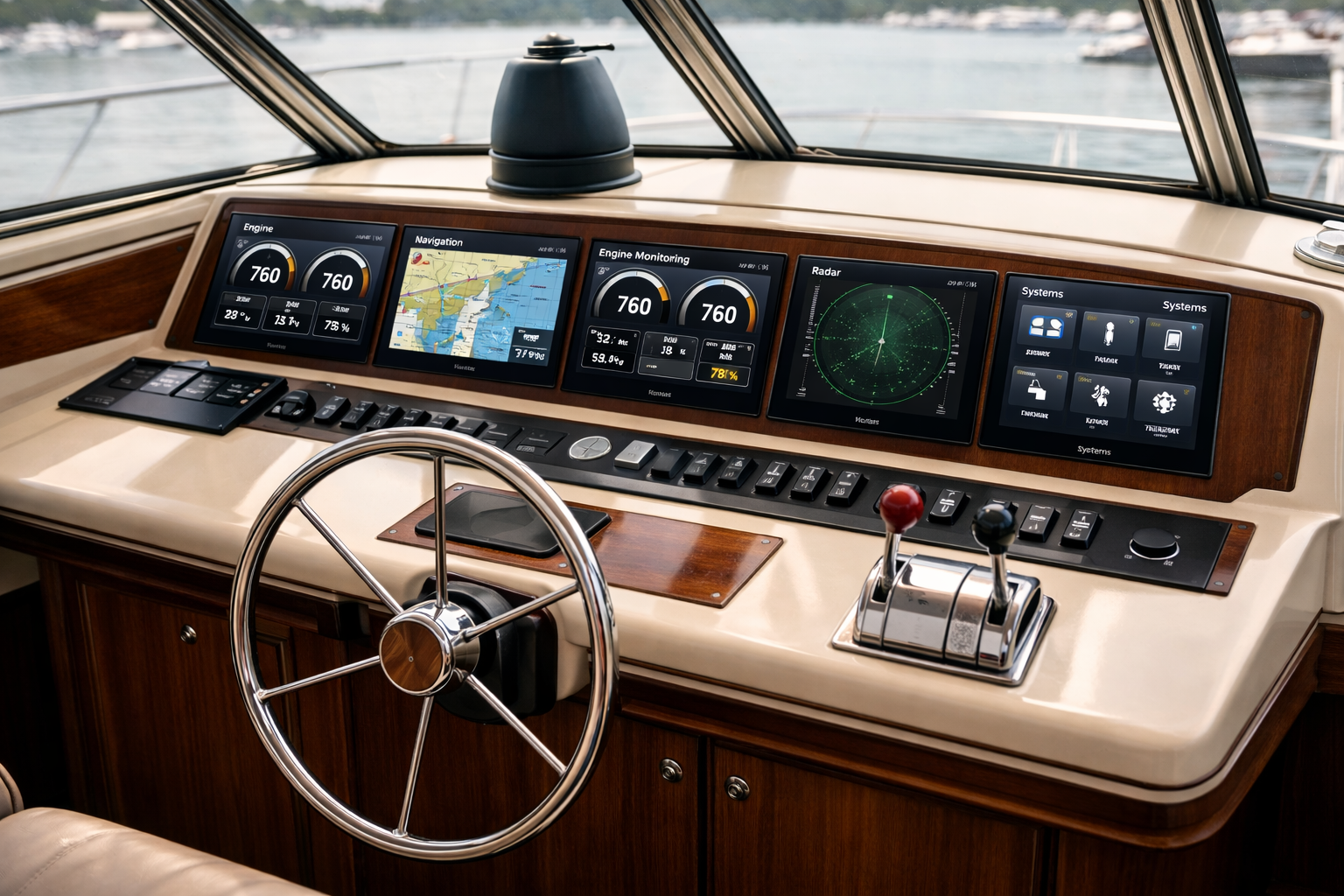
Future updates may introduce role-based and scenario-based display profiles (e.g. cruising, manoeuvring, monitoring), allowing operators to switch between layouts optimised for different phases of operation. This builds directly on the existing configurable display concept introduced in Version 1.
Incremental, Backward-Compatible Evolution
All future capabilities are planned to be introduced incrementally and backward-compatibly, ensuring that early installations remain fully supported and continue to gain value over time. Retrofit projects completed today are designed to remain relevant and expandable for years to come.